Posts

Showing posts with the label Canoes

Bark Canoes in Arnhem Land Australia
Image
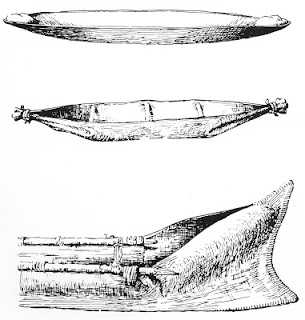
This short video clip, filmed in 1948 in Arnhem Land, Northern Territory, Australia, shows a few of the steps of building a bark canoe and a bit of paddling what appears to be a different canoe at the conclusion of a successful sea turtle hunt. Source: (Australia) National Film and Sound Archive What we observe of the canoe under construction: The bark was stripped in a rectangular section, not the ovoid or lozenge-shaped sections as were used for the canoes of the Murray Valley and as seen in the image at the bottom of this post. The bark appears to be charred on the inside of the hull. This might have been done to make it more flexible, to harden it, or to drive out insects and/or moisture and prevent rot. The bark is folded roughly in half and held upright by stakes driven into the ground, which define the width of the hull. The ends are stitched closed with what we presume is vegetable fiber. The stitching is on an angle for a bit of bow or stern overhang. The bark is cut back ...

Australian Bark Craft Canoes and Otherwise

Image
A few weeks ago I presented material from Edwin Doran on the bark canoes of Australia. I can now elaborate on that a bit, based on images from Paul Johnstone's The Sea-Craft of Prehistory . Doran's line drawing of an Australian canoe that was built by bunching and tying the ends of a half-tube of bark was obviously based on this fine early 19th-century engraving, from Lesueur and Petit's Atlas to Peron's "Voyage of Discovery." (I've transcribed the name of the source verbatim from Johnstone's caption, but unfortunately, there is no bibliography or footnote citation for this source.) In the engraving, one can see thwarts, and ties (probably bark) running across the boat, from shear to shear just above the thwarts, , but no gunwale members, ribs, or other structure. The Aboriginal people paddling in the background provide scale, showing that this was a small two-man canoe indeed. They are paddling with single-handed paddles, and they have a small fire go...

In Search of an Australian Plan Looking for plans of one of McGregor’s original Rob Roy canoes

Image
Excited to learn about kayaking as a teenager I was soon told the sport of kayaking in UK had begun with John McGregor and his Rob Roy Canoe.   Actually that’s not entirely true. I actually learned he was the founder of the sport of canoeing in Britain. Inspired by canoes and kayaks he had seen during visits to North America and Kamchatka in the late 1850s John McGregor commissioned a boat to be built by Searle & Co. Thames River boat builders in his then home town London, England. This was the first and the longest of a series of boats of similar concept he commissioned. He named it the “Rob Roy”. It served him for his first series of journeys recounted in his book “A Thousand Miles in a Rob Roy Canoe”, published in 1866. A Rob Roy Canoe, Plas-y-Brenin N.Wales McGregor’s book became very popular, spurring him on to enjoy further travels in Europe, the Baltic, and in the Middle East, and to write more books. He also took time to explore around Shetland and Orkney. He typical...