Posts

Showing posts with the label Bark

Bark Canoes in Arnhem Land Australia
Image
This short video clip, filmed in 1948 in Arnhem Land, Northern Territory, Australia, shows a few of the steps of building a bark canoe and a bit of paddling what appears to be a different canoe at the conclusion of a successful sea turtle hunt. Source: (Australia) National Film and Sound Archive What we observe of the canoe under construction: The bark was stripped in a rectangular section, not the ovoid or lozenge-shaped sections as were used for the canoes of the Murray Valley and as seen in the image at the bottom of this post. The bark appears to be charred on the inside of the hull. This might have been done to make it more flexible, to harden it, or to drive out insects and/or moisture and prevent rot. The bark is folded roughly in half and held upright by stakes driven into the ground, which define the width of the hull. The ends are stitched closed with what we presume is vegetable fiber. The stitching is on an angle for a bit of bow or stern overhang. The bark is cut back ...

Australian Bark Craft Canoes and Otherwise

Image
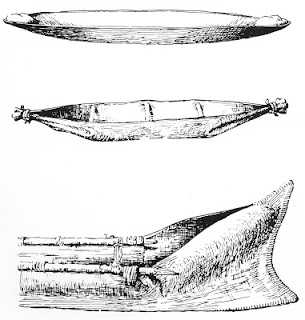
A few weeks ago I presented material from Edwin Doran on the bark canoes of Australia. I can now elaborate on that a bit, based on images from Paul Johnstone's The Sea-Craft of Prehistory . Doran's line drawing of an Australian canoe that was built by bunching and tying the ends of a half-tube of bark was obviously based on this fine early 19th-century engraving, from Lesueur and Petit's Atlas to Peron's "Voyage of Discovery." (I've transcribed the name of the source verbatim from Johnstone's caption, but unfortunately, there is no bibliography or footnote citation for this source.) In the engraving, one can see thwarts, and ties (probably bark) running across the boat, from shear to shear just above the thwarts, , but no gunwale members, ribs, or other structure. The Aboriginal people paddling in the background provide scale, showing that this was a small two-man canoe indeed. They are paddling with single-handed paddles, and they have a small fire go...

Temagami Birch Bark Canoe Project

Image
An interesting Birchbark canoe project is in the works for this summer. The folks at Voyages of Rediscovery are raising funds for a canoe build on Bear Island, Lake Temagami. They've begun their drive with a detailed video of their goals and intention (see below) Seems like worthy project to involve the youth of the island and bring back some pride in their native canoe heritage. Their project site on Kickstarter mentions their fundraising progress...they're getting close to their goal of $10,000. Their pledge page also lists some tempting "rewards" for pledges ranging from bumper stickers, T shirts, DVDs, crooked knives, for donations of $25 or more. The builders previously built a 25 foot trade canoe based from a historic HBC freight canoe photo taken on Bear Island in 1896... Photo credit: R.S. Cassels collection at the National Archives of Canada. Here are some of their Program Objectives: Film the entire project and conduct interviews with tribal community member...

Prepping the Bark

Image
Weeks after harvesting the bark, it was time to prepare the stuff for the birchbark canoe build. This involved some pre-soaking before the coiled bark could be safely unrolled on the building bed. I brought down 5 of the largest rolls down to the lake and fastened them together with some nylon cord. I managed to find an old concrete anchor with a rusted chain in the shallows of the lake used this as a tie-down point. Bark is very bouyant of course, so within each roll, I used some stones by the shore to weigh them down and submerge them fully. Dried bark rolls; Soaking in the lake After this overnight soak, the bark was carefully unrolled onto the building bed for the messiest part of the process - cleaning. The outer layers of the bark need to be scraped to remove the accumulated moss, dead bark, and general detritus in order for proper stitching with spruce root. Using a dull, broken knife picked up at a flea market for pennies (which I intend to use for harvesting pine resin later)...

Alternative Bark Canoes

Image
One of the most interesting canoe projects I've seen is the construction of a replica birchbark canoe without the all-important birchbark. Two builders in Germany have overcome the shortage of appropriate bark in their area and have instead resorted to using 3mm (1/8" thick) birch plywood which apparently can be shaped like bark around a canoe building frame. Hans-Georg Wagner has a page that documents his construction process, including authenthic spruce root lashings, cedar gunwales, ribs, and pitch for sealant. The plywood on his replica 2-1/2 fathom Tetes de Boules (Attikamek) boat is eventually stained to look like a bark canoe. Fascinating stuff although the final weight of the canoe is a whopping 72 pounds, pretty hefty for a 15 footer. Here are some shots from his site: Soaking the plywood sheets Folding up the plywood panels Lashed up plywood hull Wagner's Canoe Another site I found was Wolfram Kaukars' Pantarhei Canoe which similarly uses plywood for the hull...